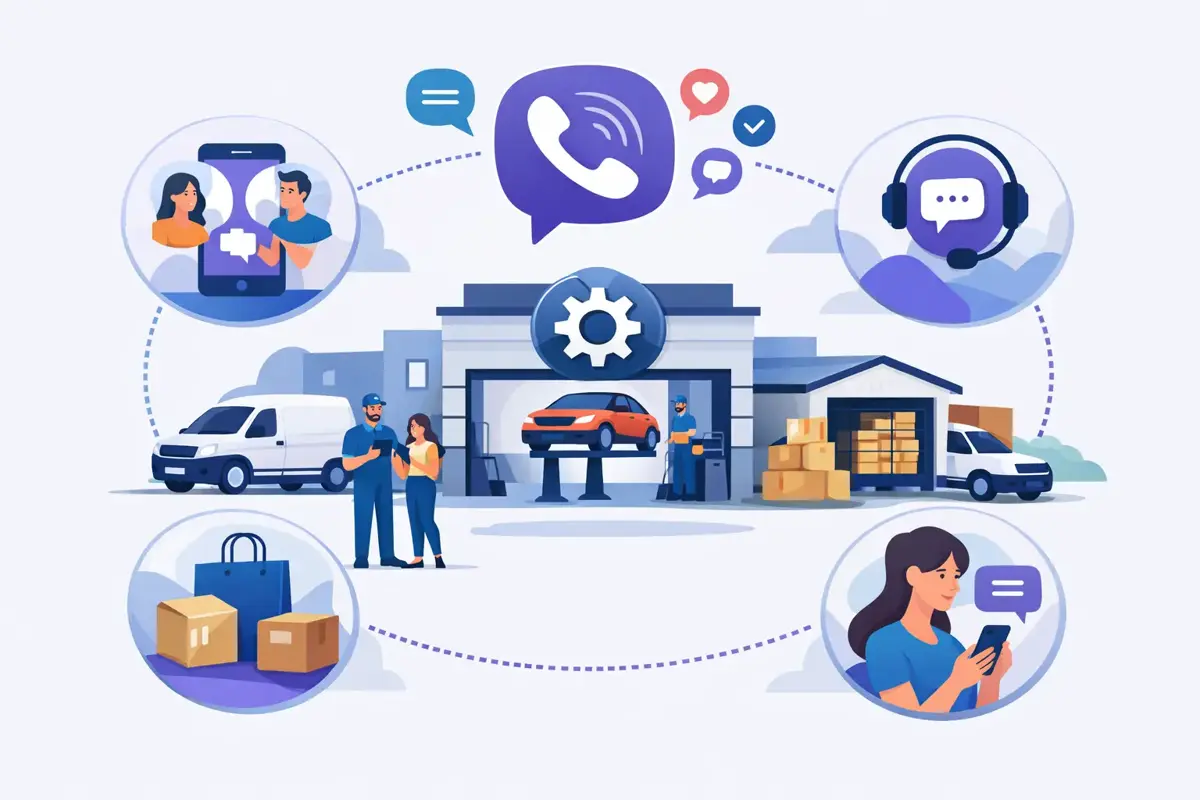
The phone rings. The dispatcher writes the address on paper. The customer sends a photo of the fault on Viber. The technician replies from the van that he is 20 minutes late. An hour later nobody is sure what was agreed, who took the job, or whether the customer got appointment confirmation. If this sounds familiar, Viber communication with customers is already part of your daily work — just probably not in a way that makes your job easier.
Viber is fast, everyone has it, and that is why it feels like the easiest solution. For a small service that is often the first step. No training needed, no extra explanation, and messages arrive instantly. The problem starts when Viber goes from a helper channel to the main place for fault intake, customer agreements and field work tracking. Then we are not talking about communication anymore — we are talking about scattered information.
Where Viber communication with customers really helps
To be fair, Viber is not the problem on its own. The problem is when it carries work it cannot hold. For simple things it can be very useful. The customer sends a photo of the device, location, model plate or a short addition to the fault description. The technician says they have arrived or are running late. The dispatcher sends appointment confirmation.
There Viber works well because it speeds up the exchange of short information. Fewer missed calls. It is easier when the customer cannot answer immediately but can send a message. For white-goods and HVAC service that often means you see the serial number, nameplate photo or installation condition before going to the field.
But as soon as the job gets two more steps, things start to break. If you need to know who took the job, what call-out fee was agreed, whether the device was already serviced last winter and whether the technician brought the right part — Viber is no longer good enough as the central place of work.
When Viber becomes a source of chaos
The biggest problem is not the message you did not see. The biggest problem is the message someone saw but nowhere recorded where it should be. In a Viber group the information exists, but it is not tied to the customer, the work order, service history or billing.
Here is a typical situation. Three months ago the customer reported the same fault. The technician wrote in the group that they temporarily fixed it and recommended replacing a part. Today a new technician goes to the same address but cannot find that message. Or it is buried under newer messages, or was sent privately, or stayed on the phone of an employee who no longer works for you.
That one detail costs you a duplicate visit, an extra call and an unhappy customer who rightly says they already reported it once.
Another problem is responsibility. When work runs through messages, it is easy for everyone to think someone else took the job. One technician saw the message, another replied "ok", a third thought the appointment was already confirmed. In the end the customer waits and you are putting out fires.
For companies with 3 to 15 employees this is especially awkward. You are not small enough to keep everything in your head, but not big enough to have a separate team that only handles administration. That is why chaos shows fastest with you — lost job, unclear status, service done but not billed, or billed but no trace of what was actually done.
Viber communication with customers is not the same as running service operations
This is the key difference. Communication is only one part of the job. Running service is much broader. It includes intake, assigning the technician, intervention status, customer history, parts used, signature, billing and reporting.
When you try to run all of that through Viber, you get work that depends on people's resourcefulness. Resourcefulness works while volume is small and everyone is fully engaged. As soon as there are more calls, more field visits and more employees, the system starts to depend on who remembered what.
It usually looks like this: fault intake is on the phone, the address in a Viber message, the device model on paper, history in an Excel sheet, status in the dispatcher's head, and the invoice in another notebook. When the customer calls and asks "What is happening with my service?", the search starts across several places.
The question is not whether your people work well. They usually do the best they can. The question is whether they have a tool that keeps the work under control.
How to keep Viber and introduce order
You do not have to shut down Viber and push customers toward something unnatural. That would be a mistake. People will still send messages, photos and locations. The point is for Viber to remain a contact channel while the work order becomes the single source of truth. That is why a special fault-report model was created: the administrator takes a screenshot of Viber information, attaches the image inside the form, and our SpinTasker program uses an AI model to fill all fields automatically in a few seconds. A very handy feature especially if you accept interventions via mobile phone. It does not have to be only a Viber screen — it can be WhatsApp, SMS, email or any image. That means every report is quickly turned into a clear job. You can easily add the technician and time, and in a few seconds you have a work order ready for execution.
When you set this up properly, you get a much calmer working day. The customer can send a message on Viber, but the job continues through the system. The dispatcher opens the order. The technician gets accurate information. Status changes as work progresses. When the customer calls again, you do not search through groups — you immediately see what happened and what the next step is.
That is where software like SpinTasker helps most — not by changing how customers communicate, but by bringing order behind that communication and speeding up processes. The customer can still send a message. You no longer have to run service from a Viber group.
What to check in your service today
If you are not sure whether Viber helps or slows you down, go through this short check:
| Question | If the answer is "no" or "I don't know" |
|---|---|
| Do you have one clear work order for each reported fault? | High chance jobs get lost or duplicated |
| Can you see customer history and past interventions from one card? | You waste time and repeat the same mistakes |
| Do you know job status in the field at any moment? | You give customers imprecise information |
| Do you know which technician is responsible for which job? | Responsibility spreads across several people |
| Do photos, messages and notes stay linked to the specific job? | Information stays buried in chat |
| Can you easily check what was done and what was billed? | The job is done but revenue leaks |
If you stopped on two or more items, the problem is probably not the people but the way of working.
Where is the boundary after which you must change habits
Some service owners delay change for a long time because the system "somehow works". That is true — it works until it costs you more than you notice. The boundary is usually not the number of messages, but the number of situations when you have to check, call and rewrite the same thing.
If you enter one job twice, if the technician asks for the address again, if the customer explains the fault from scratch to everyone and if in the evening you add up what was actually finished — it is time to cut through.
Especially if you cover several teams across a wide area. Then speed is not only organisation — it directly affects how many interventions you complete in a day. One missed agreement creates a chain delay for everyone.
Good practice is simple. Keep Viber where it is useful — for first contact and quick additions. Move everything that affects job execution into a clear workflow. Job, responsible person, status, history and field record must be in one place.
That way you reduce calls, rely less on employee memory and get a clearer picture of what brings money and what creates clutter. No need for complication. You just need work to stop living in messages.
If you are tired of searching for information in groups and copying from phone to notebook or Excel, try bringing order where it breaks most — between fault intake and completion of the intervention. It is a good moment to test it in real work, with your people and your jobs. Once you see all work in one place, it is hard to go back. See more in our tutorials and blog articles on the site. Let's be more productive.